
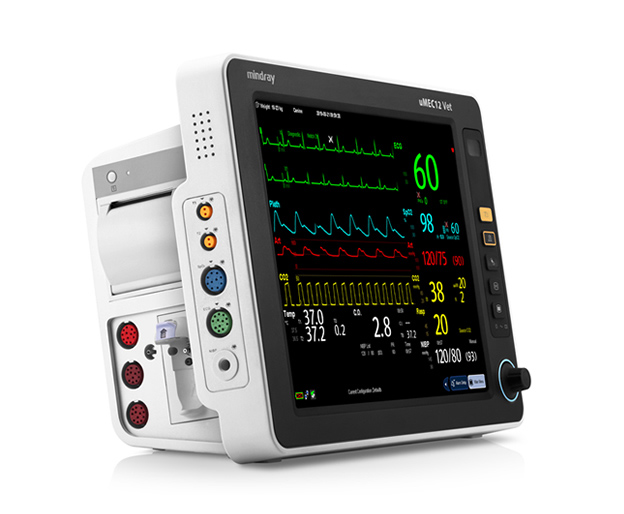
Mindray uMEC12 Vet Veterinary Monitor
Veterinary patient monitor with a 12.1-inch display, animal-specific NIBP algorithm, patented ECG with Smart Lead and a fan-free chassis that keeps hair out.
ICEN supplies selected professional medical equipment. Product availability and market authorization vary by country.
Monitoring built around animal physiology and animal hair
The uMEC12 Vet is Mindray’s veterinary patient monitor. Its 12.1-inch LCD can be reconfigured with swipe gestures, and Mindray keeps a large-font interface so a value is readable across the prep table rather than only at arm’s length.
The measurement side is adapted rather than relabelled. NIBP uses an algorithm written for animal blood flow characteristics, SpO2 is tuned for interference and weak perfusion, and ECG uses a patented algorithm with ECG Smart Lead to hold a stable trace on a moving animal. Side-stream CO2 uses a sink design that separates water, which matters for both spontaneous and mechanically ventilated patients.
The physical design addresses the two failure modes that dominate veterinary monitoring: hair and impact. There is no fan, so fur cannot be drawn into the chassis; the unit is described as fall-resistant and water-resistant; and the accessories are specified as bent-resistant. A storage box keeps the accessory set with the monitor.
Applications
- Anaesthesia and recovery monitoring
- Emergency and critical care
- Capnography during mechanical ventilation
- Dental and short procedures
Who is this product for?
- Small animal practices
- Referral and emergency hospitals
- Equine field anaesthesia
- Teaching hospitals
Selected Product Highlights
Specifications below are presented from the current ICEN product catalog. Confirm final configuration and technical documents with our team before purchase.
12.1-inch LCD with swipe-configurable layouts and a large-font view.
NIBP algorithm written for animal blood flow characteristics.
SpO2 tuned for interference and weak perfusion.
Patented ECG algorithm with ECG Smart Lead for a stable trace.
Side-stream CO2 with a water-separating sink design.
Fan-free, fall-resistant and water-resistant housing.
Mindray uMEC12 Vet Veterinary Monitor - key specifications
| Brand | Mindray |
|---|---|
| Model | uMEC12 Vet |
| Category | Veterinary patient monitor |
| Display | 12.1 in LCD |
| Layout | Swipe gestures, multiple configurations, large font |
| NIBP | Animal-specific algorithm |
| SpO2 | Interference and weak-perfusion handling |
| ECG | Patented algorithm, ECG Smart Lead |
| CO2 | Side-stream, water-separating sink design |
| Cooling | Fan-free |
| Housing | Fall-resistant, water-resistant |
| Accessories | Bent-resistant, storage box |
| Parameters | ECG, NIBP, SpO2, CO2 as configured |
Monitoring choice in veterinary practice turns on species range, anaesthesia workflow and whether the unit leaves the building. Fixed monitors suit prep rooms and theatres; portable units suit field anaesthesia, at the cost of screen size.
Common questions about Mindray uMEC12 Vet Veterinary Monitor
Why does a fan-free design matter?
Animal hair is drawn into fan-cooled monitors and blocks the airflow, which leads to overheating and repeated cleaning. Mindray removes the fan entirely on the uMEC12 Vet.
Can it monitor a ventilated patient?
Yes. Side-stream CO2 is supported, and Mindray states the sink design separates water for both spontaneous and mechanical ventilation, which is the usual failure point of side-stream sampling in animals.
How is the ECG kept stable on a moving animal?
Mindray uses a patented ECG algorithm together with ECG Smart Lead, and specifies bent-resistant accessories so movement at the connector does not break the trace.
What parameters does it measure?
ECG, NIBP, SpO2 and side-stream CO2 as configured. Confirm the exact parameter set and accessory list for your configuration with ICEN.
Can it be used in the field?
The housing is described as fall-resistant and water-resistant, which suits farm and equine work, but Mindray does not publish a battery run time on the product page. Ask ICEN if field use without mains power is required.
How does it differ from a human patient monitor?
The measurement algorithms are adapted to animal physiology, particularly NIBP and SpO2, and the mechanical design targets hair ingress and impact. A human monitor relabelled for veterinary use does not carry those changes.
Related products and resources
Need a quotation or product configuration?
Send the model, estimated quantity, destination market and required configuration - our export team will reply with availability, documentation and pricing.