
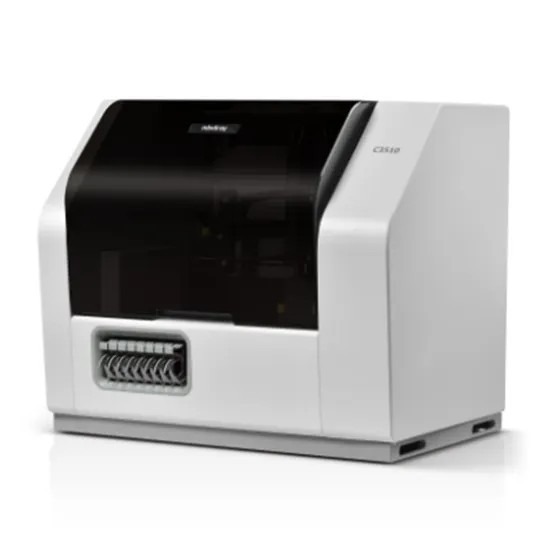
Mindray C3510 Auto Coagulation Analyzer
Mindray C3510 auto coagulation analyzer with four mechanical clotting channels at 300 T/H, six optical channels at 100 T/H, and CLSI-recommended viscosity-based detection.
ICEN supplies selected professional medical equipment. Product availability and market authorization vary by country.
Mechanical clotting detection with an optical channel alongside
The C3510 is a fully automated coagulation analyzer aimed at mid-to-high volume laboratories. Its detection principle is the classic mechanical method: clotting is detected by viscosity change rather than only by optical density, which is the approach CLSI recommends and which Mindray states is insensitive to icteric, lipaemic, chylous and haemolysed samples.
The instrument runs two kinds of channel in parallel. Four independent clotting channels cover PT, APTT, fibrinogen and thrombin time with a maximum throughput of 300 tests per hour. Six independent optical channels cover chromogenic and immunoturbidimetric assays such as D-dimer and AT-III at up to 100 tests per hour.
Sample racks load through a drawer, which keeps the working deck accessible while the analyzer is running. Sample and reagent probes are separate, both with liquid-level detection and vertical collision protection, which Mindray presents as the basis for low carry-over between tests.
Applications
- Routine coagulation screening: PT, APTT, fibrinogen, thrombin time
- D-dimer and FDP by immunoturbidimetric assay
- Antithrombin and other chromogenic assays
- Laboratories handling lipaemic, icteric or haemolysed samples
Who is this product for?
- Mid-to-high volume hospital laboratories
- Laboratories where sample quality varies widely
- Sites running routine and specialty coagulation on one platform
- Hospitals replacing semi-automatic coagulation benches
Selected Product Highlights
Specifications below are presented from the current ICEN product catalog. Confirm final configuration and technical documents with our team before purchase.
Mechanical viscosity-based clotting detection, the method recommended by CLSI.
Insensitive to icteric, lipaemic, chylous and haemolysed samples.
4 independent clotting channels with a maximum throughput of 300 T/H.
6 independent optical channels for chromogenic and immunoturbidimetric assays, up to 100 T/H.
Combo coagulation profiles: 4 parameters at 60 samples/h, 5 parameters at 40 samples/h.
Separate sample and reagent probes with liquid-level detection and vertical collision protection.
Mindray C3510 Auto Coagulation Analyzer - key specifications
| Brand | Mindray |
|---|---|
| Model | C3510 |
| Category | Automatic coagulation analyzer |
| Testing principle | Mechanical, viscosity-based detection for clotting items; optical channels for chromogenic and immunoturbidimetric assays |
| Clotting channels | 4 independent channels, maximum throughput 300 T/H |
| Optical channels | 6 independent channels, maximum throughput 100 T/H |
| Combo 4 parameters | PT / APTT / Fib / TT at 60 samples per hour |
| Combo 5 parameters | PT / APTT / Fib / TT / D-Dimer at 40 samples per hour |
| Interference tolerance | Insensitive to icteric, lipaemic, chylous and haemolysed samples |
| Sample loading | Drawer loading design for sample racks |
| Probes | Separate sample and reagent probes, both with liquid-level detection and vertical collision protection |
| Intended workload | Mid-to-high volume laboratories |
Coagulation analyzers differ mainly in detection principle, channel count and whether chromogenic assays are supported. The C3510 combines mechanical clotting channels with optical channels, which lets one instrument cover screening and specialty assays.
Common questions about Mindray C3510 Auto Coagulation Analyzer
Why does the detection method matter?
Mechanical viscosity detection measures the clot itself rather than a change in optical density, so it is not confused by coloured or turbid plasma. Mindray states the method is insensitive to icteric, lipaemic, chylous and haemolysed samples, and it is the approach CLSI recommends.
What throughput can I expect for routine screening?
The four clotting channels run to a maximum of 300 tests per hour. A four-parameter combo (PT, APTT, fibrinogen, thrombin time) is stated at 60 samples per hour, and a five-parameter combo including D-dimer at 40 samples per hour.
Can it run D-dimer and other immunoassays?
Yes. Six independent optical channels handle chromogenic and immunoturbidimetric assays, including D-dimer, at up to 100 tests per hour.
How is carry-over controlled?
Sample and reagent probes are separate, and both have liquid-level detection and vertical collision protection. Mindray presents this separation as the reason carry-over stays low.
How are samples loaded?
Sample racks load through a drawer, so racks can be changed while the analyzer continues processing.
How does it compare with the C3100?
Both are Mindray coagulation analyzers; the C3510 is the higher-throughput model with four clotting and six optical channels. Ask ICEN for a side-by-side configuration sheet if you are choosing between them.
Related products and resources
Need a quotation or product configuration?
Send the model, estimated quantity, destination market and required configuration - our export team will reply with availability, documentation and pricing.